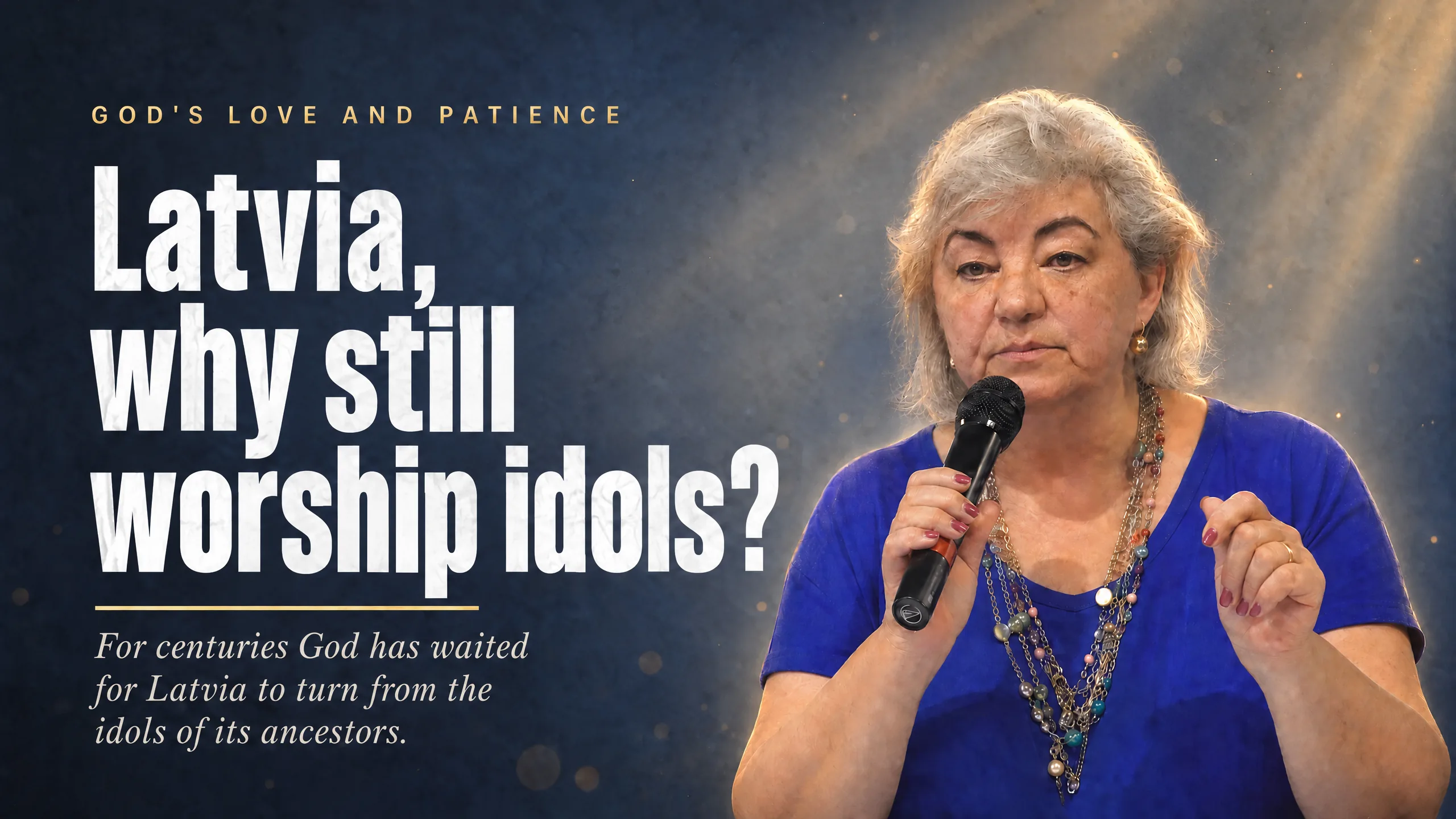
God’s Love and Patience
Preacher: Ingūna Rožkalna
Livestream: youtu.be/_Jlb9a412q4
Date: 2026-06-21 Title: God’s Love and Patience Speaker: Ingūna Rožkalna
Opening Prayer
[Transcription note: the following section is a live interpretation of the opening prayer. Repetitive transcription noise has been collapsed.]
Thank you. Amen. God bless you. I love you.
I want to see. God is.
And this day, when it has already grown, we will bring our land before You, our kingdom before You, our country before You.
Glory to God.
Thank you, God – for that which is from the Lord, which is for good and not for evil, which brings life, prosperity, and holiness, the Lord’s resurrection, wisdom, and financial support. That is how Latvia has become so powerful, because You said it. You said it, and we will return it back to You in humility, prayer, and faith.
Thank you, Lord, for the gifts You have given. Thank you, Lord, for those who are already on the way. Thank you for those who are close by. And Lord, thank you for everyone You continue to work for.
Let Your work – let Your will, which is for them, which is for God – be heard, let it be heard. And let it be realized here on earth. In the name of Jesus Christ we pray. Thank you for Your wisdom. Thank you for Your growing strength. Amen.
Introduction
Welcome and Opening Remarks
We thank You, Lord, for these new mountains that You are raising up. Let us drink the wine that You have prepared for this day. Lord, we thank You for all the things You are keeping in order. They are not wearing out the victory. This is the word for this time – to change fate, change the atmosphere, change history.
Let’s pray.
Thank you for the fact that You love us so much. Thank you for the fact that You are always with us. Thank you, Jesus, for Your sacrifice. Thank you for Your resurrection from the dead. Thank you for Your freedom and life. Thank you for Your truth. In You, Lord, there is liberation from evil.
The Sermon Topic
Thank you, speakers. I really hope that You will help me today to express this word in the right words. And God, thank you for giving me the ability to pass on all that You have given me and those thoughts that I have.
Today’s topic has been burning in my heart for a while. In the beginning I thought it was nothing special, but when our pastor asked me to take responsibility for a sermon, I began to pray, and the word in me became alive. So that is why the topic of this sermon is God’s Love and Patience.
I would like to start this sermon with the words: “If my people repent and come to Me, I will forgive them.”
Part I – The Historical Roots of Latvia
Travelling Back to the Bronze Age
In order to see the root of sin, we have to turn to ancient history – travelling back to the Bronze Age, the time when different tribes were living in the territory of our country: the Curonians, the Selonians, and others. In the northern part, there were also Finnish tribes.
Roman sources mention Baltic tribes starting from the first century. One of the Roman emperors mentions the Aesti, who lived near the Baltic Sea. According to historians, these people were close to the Baltic peoples.
The Formation of Latvian Tribes
At the same time, the culture of Courland was being formed – the Curonian culture in the south, the Latgalian culture in the east, and territories inhabited by the Livonians along the upper part of the River Daugava from the 9th to the 12th century, before this territory was occupied by the Crusaders.
Five main tribes were formed:
The Curonians were famous for their sea trade. The Semigallians occupied the plateau of Zemgale; they were mostly farmers and formed a powerful army against the Crusaders. The Latgallians, who lived in the eastern part of Latvia, had connections with the Muscovite lands. The Selonians were culturally close to the Latgallians. Meanwhile, the Livonians lived along the River Daugava and the Baltic Sea coast.
Most of the ancient Latvian tribes were farmers. They also engaged in fishing and applied sciences. They were good warriors, but family was the most fundamental thing.
The Amber Road
Trade was also well developed in those times because of the Amber Road – the link between Europe and Latvia. In medieval times, amber obtained from the Baltic Sea was a precious commodity; it was called Baltic gold.
The Amber Road was a trade system that connected the Baltic Sea coast with the Mediterranean countries and Central Europe. This route was formed around the second and third centuries before Christ. It especially flourished during the time of the Roman Empire, because amber was used for all kinds of jewelry and also for making religious tools and objects. Baltic tribes exchanged amber for bronze, iron, glass, jewelry, weapons, and other goods.
It was exactly at those times that Europeans seriously discovered the Baltic lands, and the territories occupied by Baltic tribes became a part of Europe.
The Baltic Language Branch
The Baltic languages belong to the Indo-European branch of languages. Baltic is an ancient group of nations. Nowadays, only two Baltic languages survive: Latvian and Lithuanian. The Latvian language has accumulated many foreign words, while Lithuanians are trying hard to keep their language clean.
It is worth noting that while Latvians had a connection with Rome and Greece, also in religious matters, they merged together. In the past there was a third Baltic language – Libonian – but it is now extinct.
Part II – Ancient Latvian Religion and the Gods
Nature-Based Religion
The basis of Latvian and ancient Baltic tribal religion was rooted in nature. People believed that nature is represented by the sky, the earth, fire, and water, and that all of these were considered to be endowed with supernatural powers. Ancient Balts also honored their ancestors.
For those times, this religion was a kind of survival religion. They used to bring offerings to their gods in order to have a good crop every year. According to their belief, God was the god of the earth and of human souls.
The Latvian Deities
The ancient Latvian pantheon included several key deities:
Māra was a goddess of the household and the mother. Laima was considered the goddess of destiny, who determined the fate of every person. Pērkons was a ruler – the god of lightning, thunder, and power. The Sun was considered a goddess who gives light, life, and fertility. Jānis (Jāņi) was the god of fertility, the harvest, and light.
German researcher Wilhelm Mannhardt, a researcher of Baltic tribes, proved that Jānis was not a minor god but a central one, because from ancient times Jānis was related to harvest and fertility. As we can see, a similar classification exists in all European nations. Because Latvia had a link with the Roman Empire, most probably those religious concepts came as a result of influence from Rome.
Living Traditions Today
Up to now, people in our country maintain their cultural traditions and customs from ancient times – through national music ensembles, the Latvian Museum of Nature, schools and the educational system, self-government, and also through neo-pagan groups. All these institutions are maintaining those religious events with the purpose of preserving Latvian culture and handing those traditions on to the next generation, also to strengthen cultural identity.
They are also trying to revive the old traditions and rituals and maintain links between the people and nature. This also has to do with the development of tourism and business.
As you know, I am not going to mention all the celebrations of the Latvian people, but still two of them are extensively celebrated: namely, the winter solstice and the summer solstice, as well as the day of Passover. All three are the most important celebrations of the ancient Baltic tribes.
The core concept of the Baltic religions was the conviction that the human being is truly connected with nature, and therefore must honor his ancestors and nature.
Part III – The Novel Lāčplēsis and Its Spiritual Significance
The Setting: Lielā Vārde
And here we come to the point – we arrive at our place at Lielā Vārde and the famous epic Lāčplēsis (“Bear Slayer”). I expected God to speak to me through a dream, but God showed me Lāčplēsis.
The epic Lāčplēsis by Andrejs Pumpurs was first published in 1888. But it is not just a literary masterpiece – it is also a symbol of Latvian history.
Andrejs Pumpurs was a humble man, and through this epic he tried to help his nation grow. The epic was written as a commission from the Latvian nation, but before he wrote it, he studied many national fairy tales and other pieces of literature. There are many hidden keys in this novel.
The Main Heroes and Their Symbolism
The main hero, Lāčplēsis, is a symbol of freedom, but at the same time he is the son of a bear and a woman. Spīdola was a witch who later became a symbol of spiritual growth. Kangars is a traitor – a symbol of treachery. The Black Knight is a symbol of foreign power; he symbolizes the Crusaders.
All in all, the Black Knight symbolizes more than just a foreign power.
The Council of the Gods
In this epic there is a meeting held by the gods, and the god of thunder introduces Christ to the assembly. The thunder god tells the story of Christ, and at this meeting all those gods acknowledge Jesus and the great work done through Him. They acknowledge it, and Jesus is glorified.
But due to the fact that Christianity came by the power of the Crusaders, one of those gods at the meeting stands up and says: “I count myself as the god of the little Latvian nation, but fate has assigned me a place in…”
Here he mentions all the other gods worshipped by the ancient Latvians. He also mentions the Roman gods.
The Word “Līgo”
In the beginnings of this epic, the word Līgo appears. In ancient dictionaries, this word is interpreted as worship and praising, because all of nature is rejoicing. The whole of nature worships Jānis. The ancient Latvians decided they would worship Jānis, whose task was to bless the people.
And the god Līgo, at those meetings, used to talk about oncoming trials. He called people to preserve their spirit – in other words, the god Līgo called people to oppose Christ. So when we analyze this meeting, we can clearly see that those so-called gods knew exactly who Jesus was, and they knew that Jesus came to set people free.
But it was the god Līgo who decided not to let people come to Christ. He acted like a deceiver. And the songs he promoted – named Līgo songs – led the Latvian people away from God, from the true God, and from Jesus. The spirit of Līgo turned the eyes of the people away from Jesus.
I recommend you watch Sandra’s sermon and Diana’s sermon again, where it was made clear what happened and why it is so dangerous for us. But my task today is to show you the god Līgo and the god of Jānis.
The god Līgo is very sly.
Part IV – The Crusades and the Christianization of Latvia
The Arrival of the Crusaders
At the end of the 12th century, the Crusaders launched their wars, which are also depicted in the epic Lāčplēsis. The purpose of those Crusaders’ wars was spreading the Roman religion, conquering new lands for European feudal lords, and growing the military Crusader orders.
At the beginning of the 12th century, Bishop Meinhard arrived in Latvia. He tried to convert the Livonians into Christianity in a peaceful way, but he failed. He was followed by Bishop Berthold, who used military force, but at the end of the 12th century this bishop was killed in battle.
He was followed by Bishop Albert, who, at the beginning of the 13th century, established Riga, which became the center of German influence in the Baltics. This gave the beginning to the process of submission to the Germans.
Resistance and Conquest
Only the Curonians, the Selonians, and some Latgallians resisted hard. There were several large battles between the Crusaders and the Baltic tribes, and in both major battles the Crusaders were defeated.
Only at the end of the 13th century did the Crusaders finally manage to conquer Semigallia. The Crusaders were there to remove the local rulers from power. They established Christian states and included the lands in the Livonian Order, the Livonian Confederation, and the Hanseatic Union. The formed confederation integrated the Baltic lands into the European system.
The Identity of the Latvian People
As many of you studied at school, the German nobles generally called Latvians “peasants” – basically, people who lived in the countryside. With time, it became a name for the local people. But later, when Latvian identity revived, people began to call themselves Latvians.
So the attempt to convert local tribes into Christianity in a peaceful way failed, and force was applied. But Latvians clung together and clung to their gods.
God’s Borders for the Nations
Meanwhile, God set borders so that in a thousand years, Baltic tribes too could have their borders. Those borders have not changed much. And this is how God’s love is revealed.
Deuteronomy 32:8 When the Most High gave the nations their inheritance, when He separated the sons of man, He set the boundaries of the peoples according to the number of the sons of Israel. (NKJV)
Acts 17:26-27 And He has made from one blood every nation of men to dwell on all the face of the earth, and has determined their preappointed times and the boundaries of their dwellings, so that they should seek the Lord, in the hope that they might grope for Him and find Him, though He is not far from each one of us. (NKJV)
Even though Baltic tribes had been sticking to their own traditions and beliefs, they gradually submitted. And God sent a revival to these tribes.
Part V – Revivals in Latvia
The Brotherhood Movement (18th Century)
In the 18th century, a movement of spiritual brothers – the Brotherhood Movement – took place. It also spread into parts of Russia. This movement was especially strong in Vidzeme, in the Brotherhood Churches.
At that time, across much of Europe, people of higher social standing had no literacy skills – but Latvians had them. Those who had literacy skills were asked to teach others. Thus, the persistence of those dedicated people prompted many Latvian farmers to learn to read and write. In those times, literacy was a huge privilege.
Choir singing was also being developed, and the first community leaders arose. It was the beginning of Latvian statehood.
The National Awakening and Further Revivals
The movement of the New Latvians in the middle of the 19th century was a time of national awakening. At the end of the 19th century there was a second revival. It was a time when the Latvian state was being established. The third revival came at the end of the 20th century.
This does not mean there were no other revivals in between. Also, certain local revivals took place between those great revivals, and they too formed and strengthened Christianity in Latvia.
The Brotherhood Movement had been active for 150 years, throughout the period following the Crusaders’ arrival. It became the largest revival ever seen in Latvia. But its influence began to dwindle due to modernization and the aging of its members. Many cultural events took place, but young people forgot to visit churches. These things also happened because of the consolidation of the Lutheran Church, within which the Holy Spirit was quite often suppressed. Gradually, people turned away from God – especially during the Soviet era.
The Desire to Keep National Traditions
The desperation to preserve national traditions, and the League of Līgo in particular, worked especially strongly during the Song Festival of Jāņi. You know that the banner of the Song Festival of Jāņi carries a special symbol.
The Vaidilutis was a priest of the Baltic tribes. He used to serve idols and perform all kinds of holy rituals. He kept the sacred fire in the holy places and explained the will of the gods.
When you look at the banner of Jāņi, you can see the symbol of fertility, the oak tree, and also Laima. And here we are not talking about the Christian God. There is no place for the Christian God there. It is rather the god called Līgo – representing the old traditions and old customs that do not lead to repentance.
Part VI – The High Places and the Call to Repentance
The High Places in Scripture
2 Kings 12:2-4 Joash did what was right in the sight of the Lord all the days in which Jehoiada the priest instructed him. But the high places were not taken away; the people still sacrificed and burned incense on the high places. And Joash said to the priests, “All the money of the dedicated gifts that are brought into the house of the Lord – each man’s census money, each man’s assessment money – and all the money that a man purposes in his heart to bring into the house of the Lord, let the priests take it themselves, each from his constituency; and let them repair the damages of the temple, wherever any dilapidation is found.” (NKJV)
The same thing is mentioned in 2 Kings 15:32-35. It simply shows you what goals were set by the king.
2 Kings 15:34-35 He did what was right in the eyes of the Lord, just as his father Uzziah had done. The high places, however, were not removed; the people continued to offer sacrifices and burn incense there. Jotham rebuilt the Upper Gate of the temple of the Lord. (NKJV)
And again in 2 Kings 20:32 – the same book, chapter 20:
2 Chronicles 20:32 He was thirty-two years old when he became king, and he reigned in Jerusalem twenty-five years. But the high places were not removed, so the people had not yet set their hearts on the God of their fathers. (NKJV)
The Word of God teaches us to remove all the high places. You are to remove all the high places of idol worship and discard the idols. But while you have even the smallest idol in your life, it will pull you back toward the roots of your ancestors and will not lead you to anything good. Because in this way we continue mixing with the pagan idols and we continue to commit the crimes and sins of our nation.
The Example of Denmark
I remember that before the Second World War, the people of Denmark repented of their sins, and the war did not touch them severely. If our people would repent in the same way, we too could experience God’s protection and blessing.
Conclusion
God’s Love and Patience
Throughout all of this history – the ancient tribes, the Crusades, the revivals, and the ongoing struggle with the high places – we see one constant thread: God’s love and patience toward the Latvian people.
God has not abandoned Latvia. He set boundaries for this nation, He sent revivals, He raised up leaders, and He continues to call His people back to Himself. His patience is not weakness – it is love. He waits for His people to turn from the high places, to remove the idols, and to come to Him with repentance and faith.
The word for this time is: change fate, change the atmosphere, change history – not through the old gods, not through the traditions that lead away from God, but through repentance, through the name of Jesus Christ, and through the power of the Holy Spirit.
Let us not enter the new season wearing the old garments. Let us come before God in humility, in prayer, and in faith – and let His will be done here on earth.
Amen.
Sermon delivered on 2026-06-21. Live English interpretation of a Latvian sermon.